
Key Takeaways
Revenue growth without financial systems in place is a recipe for chaos.
Having the right people on paper (accountant, bookkeeper) doesn't mean they're doing the right things.
Profit First isn't just about separating cash; it's the foundation that makes every other financial decision clearer and more confident.
A coordinated team of a financial coach, accountant, and financial planner working together is a power move most business owners don't realize is available to them.
You can have great revenue and still feel completely lost with your money. Maya knew this better than most.
She ran a thriving language and communication services business. She cared deeply about doing things the right way — she even taught herself bookkeeping. She had an accountant, a bookkeeper, and someone handling accounts receivable. By most measures, she had her bases covered and then some.
At the same time, Maya had no real idea of where her money was going, whether her pricing made sense, or what to do when extra cash showed up. She was working seven days a week, burning herself down to the ground, and still couldn’t shake the feeling that something was fundamentally off.
When a decision she made to fix her financial stress ended up creating a bigger problem, she reached out. Her goal, in her own words: I want to control my finances better and start running my business professionally.
Maya’s Full Financial Picture
When we started working together in January 2023, Maya had
$600K coming in annually
A gross profit margin of 40%
Net profit near break-even at 5%
No retirement savings
On the business cash flow management side, things were scattered. She was making 20 to 30 random draws per month for personal expenses, her personal bank account was essentially just for rent, and the rest of her money lived in a single business account, including reserves from a recent property sale.
She’d sold a rental property to pay off business debt, which worked. However, she hadn’t set aside taxes on that sale, which created a new and urgent problem.
Her back taxes were now outstanding, margins were low, and retirement savings were nonexistent. Maya was exhausted.
How We Helped Maya Get Back on Track
First: Getting the Foundation Right
We started with Profit First and a real budget. Profit First works by allocating money into dedicated accounts for profit, taxes, owner’s pay, and operating expenses. This way, when revenue comes in, you’re never guessing what’s available or hoping profit will materialize at the end of the month.
(If you’d like to know more about Profit First, you can read the first two chapters here for free.)
Once Maya’s cash was organized, we built a budget that reflected her real business numbers, which meant we could finally see where the margin was going.
Month 1-4: Finding the Leaks
With the budget in place, we cut unnecessary expenses and turned our attention to her pricing structure. After renegotiating rates with subcontractors and tightening costs, her gross profit margin began to climb.
The Unexpected (But Critical) Fix
We also caught a payroll issue that demanded immediate attention: as an LLC without an S-corp election, Maya shouldn’t have been running payroll for herself the way she was. It felt like the responsible thing to do, but it wasn’t quite right for her entity structure. We helped her understand her options, she used her current accountant to help her make the election, and it ended up saving her on taxes. Caught early, it was a straightforward fix.
Taking a Hard Look at the Financial Team
Though Maya had the right job titles in place to support her business, the people weren't delivering. Her current accountant wasn't being proactive about tax strategy, her bookkeeper was missing red flags, and her A/R person had no real follow-up process.
Good bookkeeping for small business owners goes well beyond recording transactions. It should be a system that actively flags problems, keeps your records clean, and gives you numbers you can actually make decisions with. If your books are just a year-end formality, that's a gap worth closing.
If you've ever wondered whether your small business bookkeeping is actually working the way it should, Maya's situation is a good gut check.
We helped Maya understand what each role should ideally look like, which gave her the footing to have better conversations and (eventually) make some changes. Hiring by title isn't enough if you don't know what good performance looks like in that role.
Then, Building for the Future
With back taxes paid, cash organized, and margins improved, it was time to bring in an accountant specializing in small business tax planning and a CFP to start building a retirement plan. All three of us now work with Maya as a coordinated team, each contributing a different perspective on her financial decisions.
The Transformation
Maya’s numbers changed from 2022/2023 to 2025
Revenue grew from $600K to $4.1 million
Gross profit margin went from 40% to 58%
Net profit went from 5% to 22%
Owner's pay went from $187K to $395K, with three months of paychecks sitting in a dedicated account at all times
She built a $100K business emergency fund and a $20K personal emergency fund
Two years of SEP IRA contributions, with at least $120K invested for retirement
Quarterly taxes are handled — usually with money left over in the tax account
As big as the financial transformation was, it’s only part of the story. What changed for Maya personally mattered, too. She used to arrive at coaching sessions with a stress level of 12 out of 10. Everything felt like a crisis. Now, problems are rarely urgent because she has the systems to handle them. She’d hired key leaders who took enormous pressure off her plate and gave her the kind of schedule flexibility that seemed impossible a few years ago.
Maya didn’t expect that getting her finances in order would change how she felt about herself and her business. Now that she understood the numbers and systems, the shame she felt around money lifted. In its place, she found confidence and freedom.
Ready to Stop Guessing and Start Growing?
If Maya's story sounds familiar — the revenue that should feel better than it does, the financial team that may not be doing what you think, the sense that you're working too hard for too little clarity — we'd love to talk.
At Financial Fitness Coaching, we help driven business owners build the financial systems that enable real growth. Schedule a free discovery call with our team and let's figure out what's possible for your business.
Frequently Asked Questions (FAQs)
Q: How do I know if I should make an S-corp election?
A: It generally comes down to profitability. Once your business is generating enough net profit, the self-employment tax savings can be significant if you meet the requirements. This is a decision worth making with an accountant who does proactive tax strategy, not just year-end filing.
Q: What does it mean to "stress test" a financial decision?
A: Before a major move like a key hire, a big investment, or a new service line, we run the numbers on what that decision needs to produce to work. What does this hire need to generate to pay for itself? What happens to cash flow if the return takes longer than expected?
Q: What retirement account options do self-employed business owners have?
A: More than most people realize. A SEP IRA allows contributions of up to 25% of net self-employment income and is simple to set up. A Solo 401(k) can allow even higher contributions depending on your situation. Which one makes sense depends on your income, structure, and goals, but the right choice can.
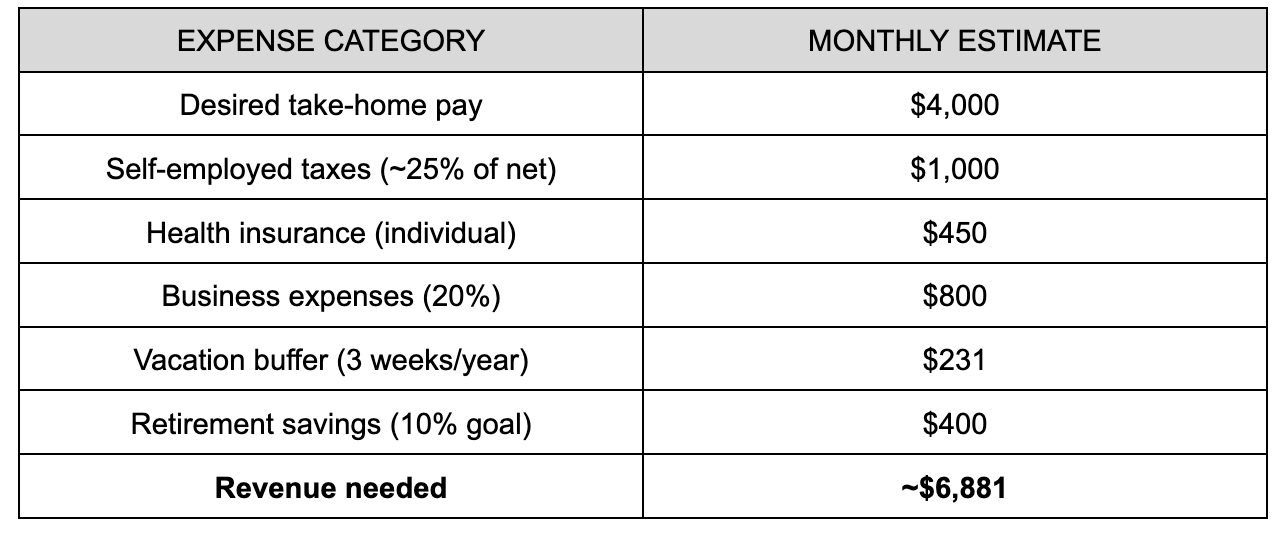
Most people only see the top line. Cash flow planning is what helps you see the whole thing — and make a decision you won't regret six months later.
When you see it broken down this way, it's clearer why $4,000 in revenue isn't enough, and why building in these layers upfront makes the transition into self-employment more sustainable.
Not Everything Gets More Expensive
Up to this point, it might seem like everything’s getting more expensive. Some things are, but there’s another side that’s worth considering.
When you’re no longer commuting, buying work clothes, or grabbing convenience meals, your spending can shift in meaningful ways when you work for yourself.
If you have kids, the math can change even more. Flexible hours mean you might be able to skip paying for after-school childcare, catch a school event without burning PTO, or simply be around in ways that reduce the logistical expenses that pile up when two schedules don't align.
You may find yourself with more time to plan and more control over how you use your money. For some, this leads to lower expenses in areas that didn’t feel optional before.
Of course, this isn’t guaranteed. But it’s a reminder that your financial picture doesn’t exist in a vacuum — it’s connected to your daily life choices.
So, When Is the Right Time to Quit My Job?
Most people are looking for a moment — a specific number, or some kind of sign that says, “This is it.” But this decision can’t be based on one great month. It needs to focus on whether your business can consistently support your life.
Look at a stretch of at least six months, ideally closer to a year. If your income has been steady enough that a late invoice doesn't send you into a panic, that's a meaningful signal. It's the average that tells the real story, not the peaks.
If you’re waiting for a perfectly calculated, zero-risk moment to leave your job, you’ll probably wait forever. But that doesn’t mean you guess and hope for the best either. There isn’t one “right” path. Some people leave earlier and accept more uncertainty. Others wait until things feel almost boringly predictable. Both approaches can work as long as the decision is intentional.
When you can check off the list below without stretching the truth, you’re closer than you think:
3-6 months of living expenses saved as a cash cushion, separate from your business account.
Your full revenue target has been met consistently for at least 6 months. This should be based on average, not best-month revenue.
Health insurance plan identified and budgeted for.
An active pipeline of future work, not just current clients, but referral sources and prospects in the queue.
Quarterly estimated taxes set up and accounted for.
Business banking and account setup. Keep business and personal finances completely separate from day one.
A retirement savings plan in place — SEP IRA, Solo 401(k), Simple IRA, or a Traditional or Roth IRA
Being prepared enough to act without second-guessing is key.
Are You Ready to Determine Your Number?
Every situation is different. Your expenses, your income, and your timeline don’t fit neatly into a generic formula. That’s where we can help.
At Financial Fitness Coaching, we can help you sort through the numbers, test your plan, and create something that’s both realistic and sustainable without forcing you into a rigid system that does not fit your life.
If you’re wondering if you’re closer than you think, or what needs to change to get you there, let’s talk. Schedule a discovery call, and let’s turn that “someday” into a date on the calendar.
Frequently Asked Questions (FAQs)
Q: What expenses do people usually forget when going self-employed?
A: Health insurance, taxes, retirement savings, and paid time off are the big ones. These don’t show up in your business revenue, but you still need to fund them.
Q: What if my income is inconsistent month to month?
A: That’s normal for most business owners. Focus on your average income over several months and make sure you have a cash cushion for slower times.
Q: When should I quit my job and go full-time in my business?
A: There's no single magic number, but a few key signals point to readiness: your full revenue target has been met consistently for at least 6 months, you have 3–6 months of living expenses saved as a cash cushion, and you have a plan for health insurance, taxes, and retirement. If you can check those boxes without stretching the truth, you're closer than you think.
Q: What is cash flow planning, and why does it matter for new business owners?
A: Cash flow planning is tracking when money comes in and goes out of your business so you can make intentional decisions — including knowing exactly when you're ready to leave your day job.
Without it, it's easy to look at your revenue and feel ready when the full picture tells a different story. This is one of the core things we work on with clients at Financial Fitness Coaching.